
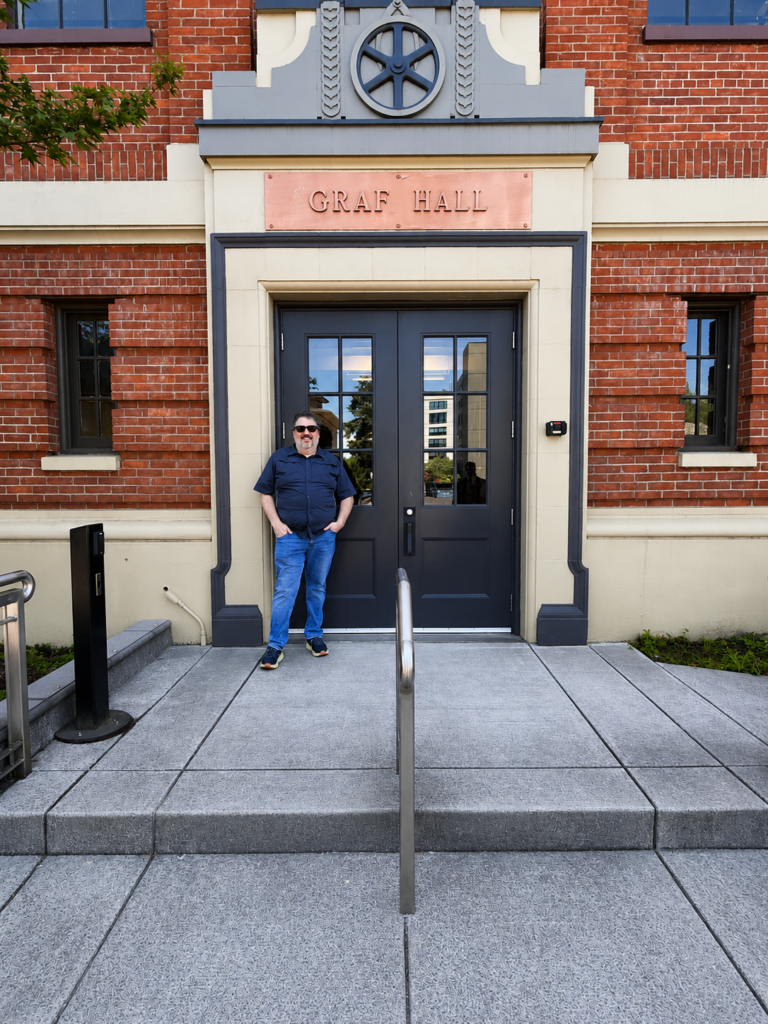
A Meaningful Discovery
As a mechanical engineer, I’ve always enjoyed seeing projects I’ve worked on—or projects created by companies I’ve been a part of—out in the real world.
There’s something special about encountering something you helped design or build after it has left the drawing board. You might drive past a building, walk through a facility, or visit a space and suddenly recognize a piece of work that you’re connected to.
So you can imagine my excitement when I discovered that Whitebird Woodcraft had built a set of doors for Graf Hall at Oregon State University.
For me, this particular project felt like much more than simply finding a Whitebird door “in the wild.”
It felt like a connection between several important parts of my life.
A Connection to Oregon State
Oregon State University holds a special place in our family.
It’s my alma mater, and I graduated from OSU with a degree in mechanical engineering.
Our son followed a similar path and also graduated from Oregon State with a degree in mechanical engineering.
So discovering that Whitebird had created doors for Graf Hall, an engineering building on the OSU campus, was a pretty special moment.
There’s something fitting about finding a piece of craftsmanship from our new business inside a building connected to the field that has shaped so much of my professional life.
From Engineering to Woodworking
My background in mechanical engineering is actually one of the things that drew me to Whitebird Woodcraft.
I’ve always enjoyed figuring out how things work, solving problems, and paying attention to the details that make something function the way it should.
I’ve also been a woodworking hobbyist for years.
Whitebird brought those two interests together in a way that immediately appealed to me.
Building custom doors requires both precision and creativity. Measurements matter. Materials matter. How individual pieces come together matters.
But there’s also an artistic side—the grain of the wood, the proportions of a design, the way a door fits into the architecture around it.
That’s what makes this work so rewarding.
Seeing the Work in a Place That Matters
Walking through Graf Hall and realizing that Whitebird had played a small part in the building was a reminder of how far a handcrafted door can travel.
It starts in a workshop.
Someone selects the materials. Measurements are made. Pieces are cut and assembled. Surfaces are carefully finished. Every detail is checked.
Eventually, that door leaves the shop and becomes part of a much larger space.
And sometimes, you get the opportunity to walk through that space yourself.
For me, seeing Whitebird’s work at Oregon State made that experience especially meaningful.
Looking Ahead
As Kelley and I continue this new chapter with Whitebird Woodcraft, I’m excited about the opportunity to build on the company’s history while bringing my own background and perspective to the business.
I’m proud of the craftsmanship that Whitebird has become known for, and I’m looking forward to seeing where our work takes us next.
And who knows—maybe I’ll keep finding Whitebird doors “in the wild.”
For now, I’m just grateful that one of those places happens to be a building at my alma mater, alongside a reminder of the engineering path that helped lead me here.